SCALIXA Scalixa Homepage

We don't build websites.
We architect digital storefronts.

Our Parisian method transforms marketing strategy into a living, measurable system. This is the blueprint.

Begin the audit

Current year benchmark

Average client decision latency reduced by 34% after strategy integration.

*Based on 12 client projects, 2025-2026. Internal team alignment measured via pre/post-project survey.

Parisian architectural facade with clean lines

The Methodology: Boundaries & Realities

Our approach is built on constraints, not promises. These are the non-negotiable pillars that shape every project.

  • Fixed Scope, Variable Timeline: We quote deliverables, not hours. Timeline adapts to client decision speed and technical integration complexity.
  • Co-Pilot Model: Your team holds the brand keys; we hold the execution system. No full handoff. We train your team on the live dashboard.
  • Data Sovereignty: All analytics and asset libraries are built in client-owned platforms (e.g., CMS, cloud storage). We provide the architecture, not the lock-in.

What Changes This Methodology?

  • B2B vs. DTC: B2B focuses on lead velocity; DTC on conversion architecture. Strategy emphasis shifts.
  • Technical Debt: Legacy systems require a dedicated "Integration Phase" before Phase 1 execution.
  • Stakeholder Count: More than 5 decision-makers? We mandate a single "Voice of Truth" champion to prevent bottleneck.
  • Regulatory Environment: Finance/Healthcare requires legal review cycles. We map these checkpoints into the timeline proactively.

"We were overwhelmed with internal debates. Scalixa's 'Creative Clarity Score' became our single source of truth, reducing weekly alignment meetings by 60%."

— Head of Growth, Series A B2B SaaS

The Three-Phase Pulse

  1. 1 Immersion: Brand + Digital Audits. Output: North Star.
  2. 2 Prototyping: MVS Build & Validate. Output: Go/No-Go.
  3. 3 Amplify: Launch, Monitor, Scale. Output: Playbook.

Shared in real-time via Project Pulse dashboard.

Phase 1: Immersion & Hypothesis Weeks 1-2

Before a single pixel is drawn, we run two parallel audits. The Brand Soul Audit excavates emotional narrative and internal stakeholder narratives. The Digital Footprint Audit maps technical performance, user behavior, and competitive gaps. These outputs converge into a single, actionable document—the "North Star"—that aligns every future decision. We reject the "brief-and-build" model; here, the brief is a hypothesis.

Client Checkpoint: Sign-off on the North Star. This is the single moment where strategic direction is frozen. Changes here are paid adjustments.

Phase 2: Prototyping & Validation Weeks 3-5

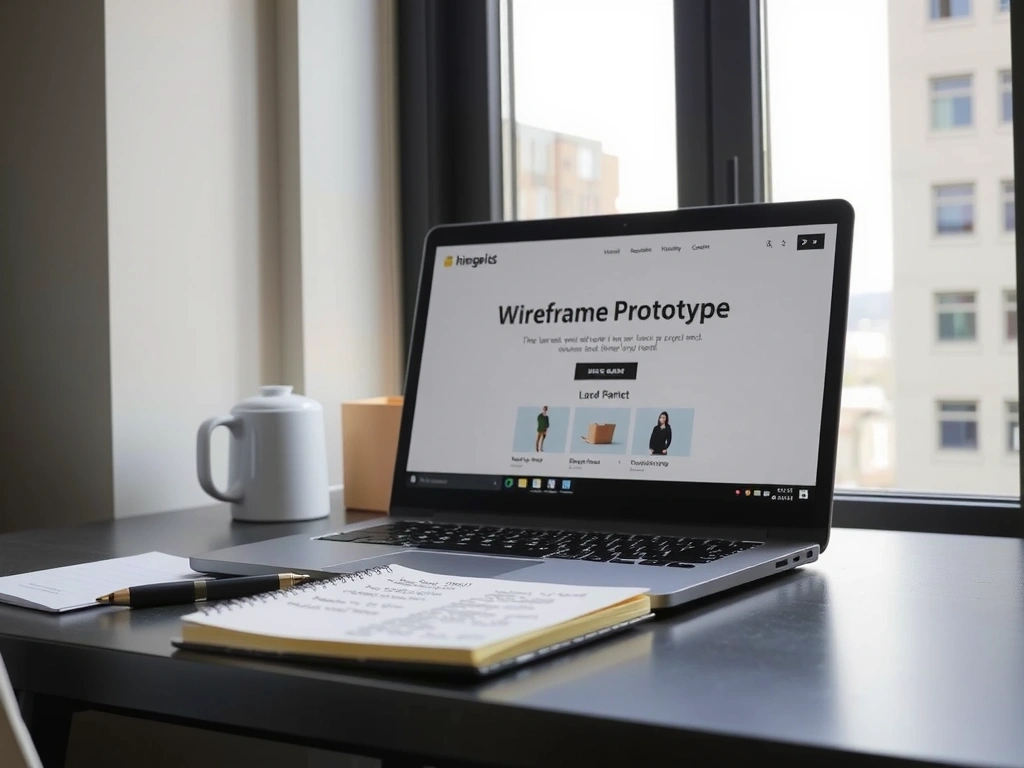
We build a Minimum Viable Storefront (MVS)—not a visual mockup, but an interactive prototype with live content modules. Key flows (e.g., product discovery, checkout) are A/B tested with real users or internal teams. The "Creative Constraint" workshop is a mandatory session where we stress-test the prototype against real-world limitations: budget, timeline, and tech stack. This is where "handoff gap" failures are prevented.

Prototype validation in a workspace

Phase 3: Launch & Amplify Weeks 6-8+

Launch is never "fire and forget." We execute a staged rollout with real-time sentiment monitoring. The output is not just a live site, but a Launch Playbook with 30/60/90-day growth levers—specific content scaling strategies, SEO milestone targets, and performance checklists. Your team inherits a system, not a static website.

Integration Mechanism

The Project Pulse dashboard is live for all phases. It aggregates key metrics (hypothesis acceptance rate, prototype usability score, launch sentiment) into a single health check.

Client Role: Co-Pilot

You are not a reviewer. You are an active participant with defined checkpoints. This model reduces revision cycles by eliminating ambiguity.

The Lexicon: What We Mean

Every agency uses jargon. Here’s how we define—and challenge—our own terms.

Creative Brief

Us: A "Living Document." It evolves with every data point. Not a one-time input, but a shared working model.

"Static briefs die at handoff. Ours lives on the Pulse dashboard."

MVS

Us: Minimum Viable Storefront. Not a product, but a system for selling. Validates narrative, not just tech.

"A prototype is a question. An MVS is an answer that's ready to sell."

Handoff Gap

Us: The critical failure point. We don't have separate strategy and execution teams. The lead strategist stays through launch.

"The gap is where brilliant ideas get diluted by 'how we've always done it.'"

Digital Footprint

Us: Not just analytics. The sum of all user behavior, technical SEO health, and competitive positioning. The "what is."

"We audit the soil before planting. You can't grow in sand."

Creative Constraint

Us: Not a limitation. The workshop where we define what cannot be done, forcing innovative solutions within the real.

"The best ideas emerge when the playground is defined."

Co-Pilot

Us: The client's mandated role. Not a stakeholder, but an active operator with dashboard access and defined decision points.

"You fly the brand; we handle the navigation system."
Method Note: Evaluating Robustness

Our method is stress-tested not by claims, but by trade-offs. We evaluate robustness via three lenses:

  • 1. Integration Fidelity: Does the system remain intact when client internal teams make edits? We test this with handover workshops.
  • 2. Decision Velocity: We track time from "insight" to "execution." A robust method reduces this over time, not increases it.
  • 3. Creative Decay Rate: How quickly does the quality of content/creative decline post-launch? Our systems are built to slow this rate.

"We don't promise 'perfection.' We build for adaptability and measurable improvement over fixed timelines."

Questions to Ask Us (and Any Agency)

1. What happens after launch?

A: We provide a 90-day playbook. Your team owns the system; we remain for strategic advisory if needed.

2. How do you measure success beyond traffic?

A: Lead quality, conversion rate, and "Decision Velocity." We align on these before the project starts.

3. What's your most common failure mode?

A: Client-side stakeholder misalignment. Our Co-Pilot model is designed to prevent this.

4. Can you work with our existing martech stack?

A: Yes, but it will affect timeline and cost. We prioritize clean integration over custom workarounds.

5. What's your average project timeline?

A: 8–12 weeks for a single storefront. Multi-region or complex integration adds phases.

Ready to audit your digital footprint?

The first step is a conversation about your constraints, not a sales pitch.

Start the conversation

14 Rue Sedaine, 75011 Paris, France

+33 1 47 00 54 90 • [email protected]